under evaluation
LoRa Mesh
We are trialling LoRa® mesh for open-source applications, commercial and non-commercial alike — local-first peer-to-peer PWAs that continue operating through internet or power-grid outages, and remain serviceable where neither exists.
For organisations and communities looking to reduce their metadata exposure — on privacy, compliance or principle — this is a structural advantage: metadata that is never generated cannot leak.
In testing
Funkpost — Post über Funk — a byte courier for local-first applications over LoRa mesh radios, Meshtastic®-compatible. Its data plane is built and tested end to end: OrbitDB databases replicate entry by entry across the mesh, between two devices whose only link is the radio — no WebRTC, no IP path anywhere (design and build plan: funkpost#1). On 4 September 2026 this first ran over a real LoRa mesh between two independent nodes, a desktop browser either side; phone Bluetooth stacks still vary — one held without a disconnect, another dropped repeatedly — and hardening them is in progress. Larger payloads follow via Storacha once either side regains internet.
In planning
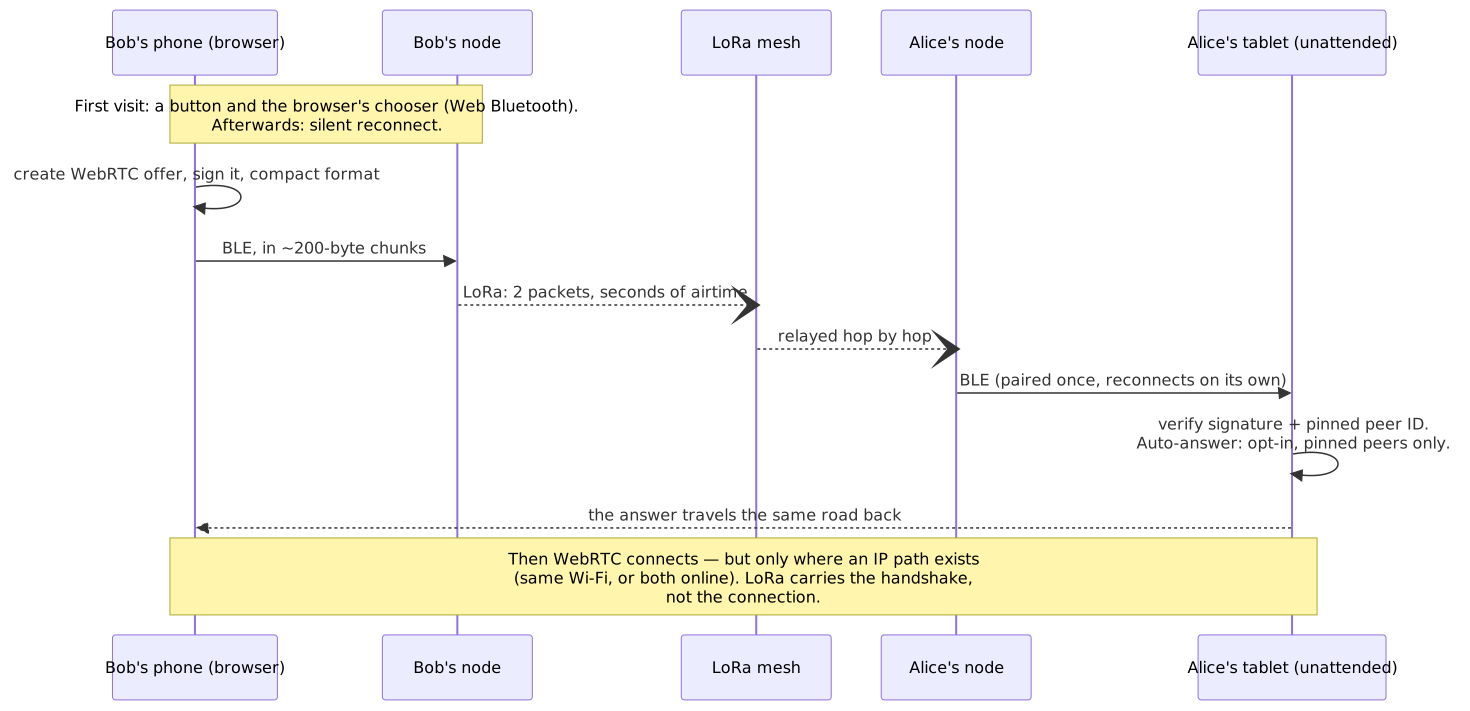
Funkpost’s second plane — the signalling courier over the mesh, as thought through in design issue #161 — two scenarios. A customer enters the studio carrying phone and radio node, and the unstaffed front desk answers automatically. Or a customer books an appointment remotely: connection set-up travels by radio rather than through a third-party signalling server. No metadata accrues with any SaaS operator — and the booking is binding regardless.
The next stage
Bluetooth LE as the feeder: stationary Chrome PWAs reconciling their data directly with mobile devices — peer-to-peer over CRDTs (OrbitDB and Yjs among them), with no servers, no accounts and no passwords. And branch devices reconciling redundantly over WebRTC and over a LoRa mesh — whichever channel is available carries the traffic; the transport-neutral synchronisation layer beneath both comes from orbitdb-storacha-bridge#50.
Fields of application
- Data-minimal booking systems without tracking — for fitness and yoga studios.
- Multi-site booking systems for coworking operators.
- P2P logistics: a consignment travels from Hamburg to Munich with registered commuters already covering the route, by rail or by car. Across several handovers, each station sees only the meeting point and the handover time; the recipient's address goes to the final one alone — and every station takes a share of the carriage fee.
- P2P argument mapping for parties, associations and civil-rights movements — structured deliberation without a central platform.
Technical foundations
- funkpost — the byte courier itself: framing, ARQ and duty-cycle pacing over Meshtastic radios — data plane built, signalling plane designed.
- webrtc-qr — the library: two devices connect by scanning a code — no signalling server.
- qr01 — the tutorial chapter for this: a todo list moves from phone to phone by scanning a code — over a Wi-Fi hotspot, with no internet involved.
- ablage — a P2P dropbox between devices and people, with no servers and no accounts — over webrtc-qr and libp2p.
- yogasuci — an emerging showcase: class bookings without intermediaries, metadata or tracking.
Partnerships
For these applications we are seeking technology partners, testers, investors and pilot customers — for deployment as a redundant path alongside the internet, in fully offline operation, or as a privacy option.
Get in touch — contact@le-space.de
On the mesh, we can be reached at le-space.de e45c, YSGs0MrcH9QOcAlIxvYkJWaV64AvKgx/tXS27SiCzXM=
The public key is what identifies us; node names are assigned by whoever operates the node. It radios in the EU-868 region and is mobile — reachable wherever it currently has a mesh in range.
LoRa® is a trademark of Semtech Corporation. Meshtastic® is a registered trademark of Meshtastic LLC. Meshtastic software components are released under various licenses, see GitHub for details. No warranty is provided - use at your own risk. This site is not affiliated with or endorsed by Semtech or the Meshtastic project.